


Gut health has become one of the most talked-about topics in nutrition—and for good reason.
From digestion and immunity to energy, mood, and even blood sugar regulation, your gut plays a central role in how your body functions.
But with all the attention, there’s also a lot of confusion.
Cut this food.
Avoid that ingredient.
Follow this restrictive protocol.
If you’ve ever felt overwhelmed by gut health advice, you’re not alone.
The truth is:
Improving your gut health doesn’t require extreme diets or complicated rules.
In this guide, you’ll learn:
- What gut health and the microbiome actually mean
- Why restrictive approaches often backfire
- What is evidence-based (and what’s not)
- How to improve gut health naturally and sustainably
- Simple, realistic strategies you can apply today
What Is Gut Health? (Featured Snippet)
Gut health refers to the balance and function of microorganisms in your digestive system, known as the gut microbiome, which influence digestion, immunity, metabolism, and overall health.
Your gut microbiome is made up of trillions of bacteria that:
- Help digest food
- Produce important compounds
- Support your immune system
- Influence inflammation and metabolism
👉 A healthy gut is not about perfection—it’s about balance and diversity
Why Gut Health Matters More Than You Think
When your gut is functioning well, you may notice:
- Better digestion
- Stable energy levels
- Improved mood
- Reduced bloating
- Better blood sugar control
When it’s not, symptoms can include:
- Bloating
- Irregular digestion
- Cravings
- Fatigue
- Inflammation
👉 This is why so many people are searching:
- How to improve gut health naturally
- Best foods for gut health
- How to heal your gut without restrictive diets
The Problem With Restrictive Gut Health Diets
Many gut health trends promote elimination:
- Cutting entire food groups
- Avoiding common foods long-term
- Following rigid “gut healing” protocols
While short-term elimination can be useful in specific cases, overly restrictive diets can:
- Reduce microbiome diversity
- Increase stress around food
- Make nutrition unsustainable
- Lead to nutrient gaps
👉 Ironically, restriction can harm the very thing you’re trying to improve.
What Actually Improves Gut Health (Evidence-Based)
Let’s simplify what truly works.
1. Increase Fiber Intake (The #1 Factor)
If there’s one thing consistently supported by research, it’s this:
Fiber is essential for gut health
Fiber feeds beneficial gut bacteria and helps produce compounds that support digestion and reduce inflammation.
Best high-fiber foods for gut health:
- Vegetables (especially leafy greens, broccoli, carrots)
- Fruits (berries, apples, pears)
- Legumes (lentils, beans, chickpeas)
- Whole grains (oats, quinoa, brown rice)
👉 Most people don’t need restriction—they need more variety and fiber
2. Add Fermented Foods (Natural Probiotics)
Fermented foods introduce beneficial bacteria into your gut.
Examples:
- Yogurt with live cultures
- Kefir
- Sauerkraut
- Kimchi
- Miso
👉 You don’t need large amounts—consistency matters more than quantity
3. Support Your Gut With Regular Eating Patterns
Your gut thrives on rhythm.
Irregular eating, constant snacking, or long gaps without food can disrupt digestion.
👉 Aim for:
- Consistent meals
- Balanced timing
- Avoiding chaotic eating patterns
4. Manage Stress (Often Overlooked)
Your gut and brain are deeply connected.
Stress can:
- Slow digestion
- Increase gut sensitivity
- Affect microbiome balance
👉 Gut health is not just about food—it’s about your nervous system too

5. Stay Hydrated
Water supports:
- Digestion
- Nutrient absorption
- Bowel regularity
👉 Simple, but essential for gut function
What About Probiotics and Supplements?
This is where confusion often happens.
Probiotics:
- Can be helpful in some cases
- Not all strains work the same
- Effects are often temporary
Prebiotics:
- Found in fiber-rich foods
- Feed your existing gut bacteria
👉 Food-first approaches are usually more effective than relying only on supplements
What the Microbiome Research Really Says
The microbiome is one of the most exciting areas in nutrition—but it’s still evolving.
What we know:
- Diversity is beneficial
- Fiber supports gut bacteria
- Lifestyle impacts gut health
What we don’t fully know yet:
- Exact “ideal” microbiome
- Personalized microbiome-based diets
👉 Be cautious of:
- overly complex testing
- expensive plans with little practical application
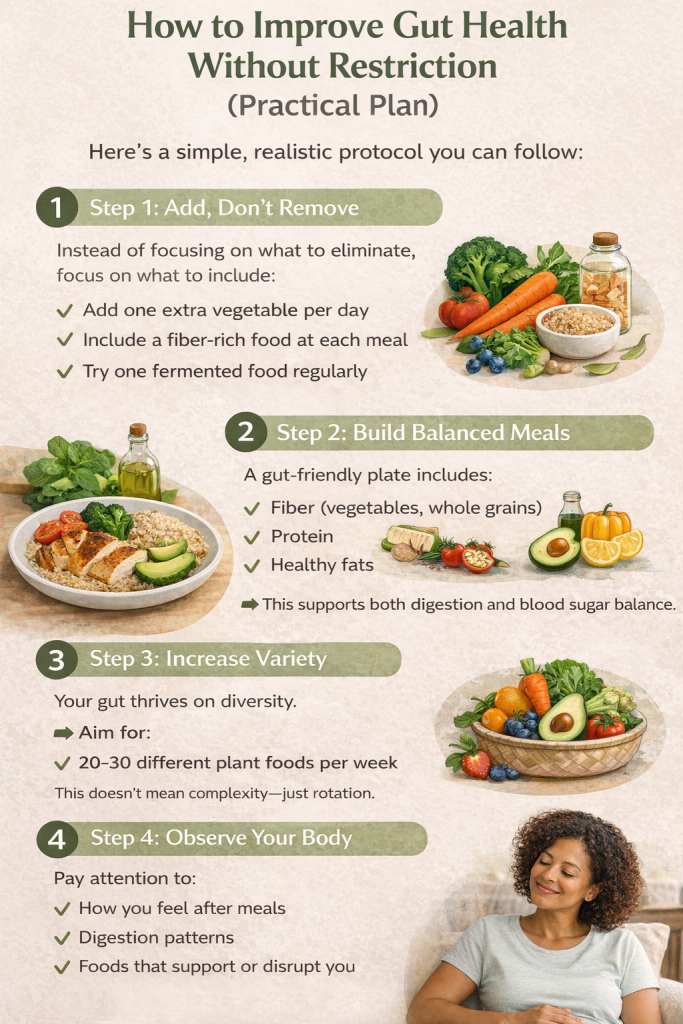
How to Improve Gut Health Without Restriction (Practical Plan)
Here’s a simple, realistic protocol you can follow:
Step 1: Add, Don’t Remove
Instead of focusing on what to eliminate, focus on what to include:
- Add one extra vegetable per day
- Include a fiber-rich food at each meal
- Try one fermented food regularly
Step 2: Build Balanced Meals
A gut-friendly plate includes:
- Fiber (vegetables, whole grains)
- Protein
- Healthy fats
👉 This supports both digestion and blood sugar balance
Step 3: Increase Variety
Your gut thrives on diversity.
👉 Aim for:
- 20–30 different plant foods per week
This doesn’t mean complexity—just rotation.
Step 4: Observe Your Body
Pay attention to:
- How you feel after meals
- Digestion patterns
- Foods that support or disrupt you
👉 This is the foundation of personalized gut health
Step 5: Avoid Extreme Rules
You don’t need:
- perfect eating
- rigid protocols
- fear-based restrictions
👉 Consistency beats perfection
Save and print this free roadmap to manage gut health:
Gut Health and Blood Sugar: An Important Connection
Your gut microbiome plays a role in:
- glucose metabolism
- insulin sensitivity
- inflammation
This is especially relevant for individuals with:
- diabetes
- prediabetes
- insulin resistance
👉 Improving gut health can support better blood sugar control
This is a key area of focus at Madalyn Nutrition, where gut health and metabolic health are approached together—not separately.
Common Gut Health Myths (Debunked)
❌ “You need to cut out many foods to heal your gut.”
👉 Not true—diversity is more important than restriction
❌ “Probiotics alone will fix your gut.”
👉 Not without dietary and lifestyle support
❌ “There is one perfect gut health diet.”
👉 Gut health is individualized, not one-size-fits-all
The Sustainable Approach to Gut Health
The most effective strategy is also the simplest:
- Eat a variety of whole foods
- Include fiber consistently
- Reduce unnecessary restriction
- Support your lifestyle (sleep, stress, hydration)
👉 Gut health is built over time—not through short-term fixes

Frequently Asked Questions About Gut Health
- How can I improve my gut health naturally?
You can improve your gut health naturally by eating more fiber-rich foods, increasing the variety of plants in your diet, adding fermented foods such as yogurt or kefir, staying hydrated, managing stress, and maintaining consistent eating habits. For most people, improving gut health does not require a highly restrictive diet. - What are the best foods for gut health?
Some of the best foods for gut health include vegetables, fruits, legumes, oats, whole grains, nuts, seeds, yogurt with live cultures, kefir, kimchi, sauerkraut, and other fermented foods. These foods help support a healthier and more diverse gut microbiome. - Do I need probiotics to improve gut health?
Not always. Probiotics can be helpful in some cases, but they are not a magic solution. A food-first approach that includes fiber, prebiotics, and fermented foods is often more effective for long-term gut health than relying on supplements alone. - Can restrictive diets harm gut health?
Yes, in some cases. Overly restrictive diets can reduce the diversity of foods you eat, which may negatively affect the diversity of your gut microbiome. Unless medically necessary, long-term restriction is usually not the best strategy for improving gut health. - How much fiber should I eat for better gut health?
Most adults benefit from increasing fiber intake gradually through foods such as vegetables, fruits, beans, lentils, oats, and whole grains. The right amount can vary from person to person, but consistency and variety are key for supporting digestion and the gut microbiome. - How are gut health and blood sugar connected?
Gut health and blood sugar are closely linked. A healthier gut microbiome may help support better glucose metabolism, lower inflammation, and improved insulin sensitivity. This is especially important for people with diabetes, prediabetes, or insulin resistance. - How long does it take to improve gut health?
Gut health improvements can begin within a few days or weeks of consistent dietary and lifestyle changes, but lasting results take time. The goal is not a quick fix, but building sustainable habits that support digestion, microbiome diversity, and overall health.
Ready to Improve Your Gut Health—Without Overcomplicating It?
If you want a realistic, evidence-based approach tailored to your body and your lifestyle:
👉 Explore personalized nutrition support at Madalyn Nutrition
👉 Follow for practical tips and education: @diabetes.rd
Learn how to:
- improve your gut health naturally
- support digestion and metabolism
- build sustainable habits that actually work
Final Thoughts
You don’t need to eliminate everything to feel better.
You don’t need a complicated protocol.
You don’t need perfection.
👉 You need:
- consistency
- variety
- and a strategy that fits your life
Because real gut health isn’t built through restriction.
It’s built through balance.